After my diving adventure in the Galápagos, I wanted to explore more of Ecuador’s treasures. However, time was running short, and there were still so many things left to discover on my list for the next trip.
I visited Cuenca and Quito, and I even had the opportunity to meet Carmen Orellana, a master of the art of weaving ikat. But let’s take it step by step.
To reach Cuenca from Guayaquil, you can either take a 4-hour bus ride through a mountain pass or a flight. I was a bit concerned about finding a bus in the afternoon and worried that I might have to spend the night in Guayaquil, which I wasn’t eager to do due to its reputation as a dangerous city. However, luck was on my side. At the Galápagos airport, I struck up a conversation with a young woman. It turned out that her mother was picking her up at the airport, and they kindly offered to take me to the minibus stop (safer option) that goes directly to Cuenca, right across from the Hilton hotel. It was perfect, and the journey through the mountain pass was incredibly beautiful, giving me a glimpse of the nearby Cajas National Park’s beauty.
Cuenca’s historic center, the historic center of Quito, and the ikat weavings for Macanas are all recognized as UNESCO World Heritage sites.
The astonishing architectural beauty and excellent preservation of this cultural heritage are overwhelming.
Cuenca was founded in 1557 and is situated at an elevation of 2,550 meters (8,366 feet) above sea level, with a history that can be divided into three eras: the pre-Inca era that lasted for about 1,000 years, the Inca era that spanned 700 years, and the Spanish rule that endured for approximately 300 years (rounded figures). The Pumapungo Museum explains the city’s rich history, marked by conquests and reconquests. Simultaneously, the Remigio Crespo Toral Museum portrays the colonial history, explaining the development of the class-based society of that time, including the famous straw hat called “sombrero de paja toquilla,” often mistakenly referred to as the “Panama hat” (Winston Churchill recognized the hat during his visit to Panama, but it had already been seen and used in Ecuador). The hat museum is quite interesting, and the hats are exquisite.
Today, Cuenca is experiencing significant economic and tourism growth and is the number one national destination. It is positioning itself as a preferred location for weddings with the brilliant tourism campaign “Say Yes,” managed by the city and the local tourism office. With its 52 churches, diverse accommodation options, and excellent gastronomy, Cuenca is well-suited for weddings. Gastronomic projects like the restaurant “La María” are fascinating due to their modernization of local cuisine. That being said, it’s worth visiting the local market, such as the one on 10 de Agosto Street. On the first floor, there are popular eateries serving all kinds of local dishes, including roasted pork, “el chancho,” a typical regional dish. It’s very tasty, and the portions cost between €3, €4, or €5, depending on size. I ended up ordering two €3 portions because I thought a €5 one would be too much. It’s as good as the roasted suckling pig in Segovia and Ávila.
In Calderon Square, the city center, you’ll find a very peculiar church, the Old Cathedral. It was built in 1557 with stones from the ruins of Tomebamba (the administrative center of the northern Inca empire). Its structure is unique and well worth a visit. Here, I stumbled upon a very entertaining spectacle. A professional actor was giving a “guided tour of the church” to a group of schoolchildren, around 10 years old. He recounted Bible stories and the history of the church in a mysterious and suspenseful manner. The children were captivated and would probably experience the Bible and history in a much more vivid way from that day on.
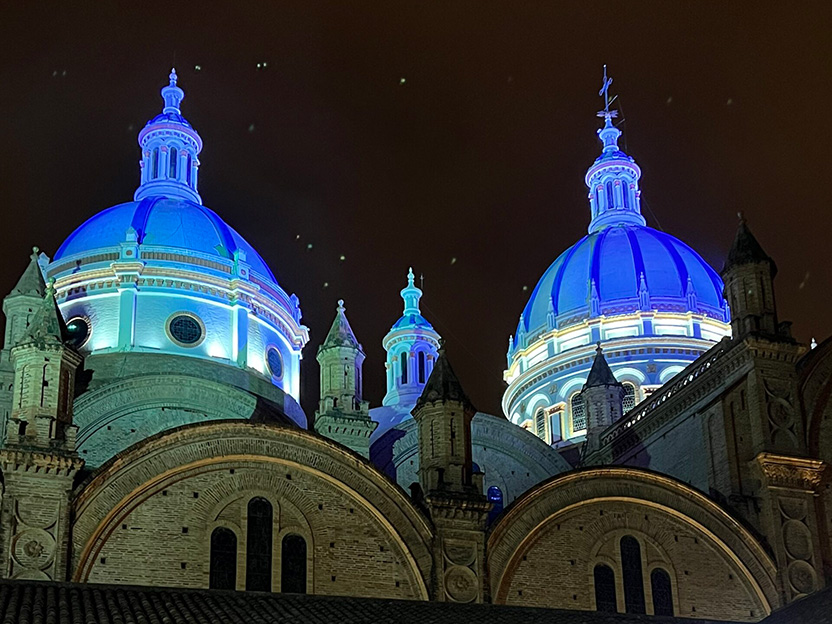
I must admit I have a weakness for colonial houses. “La Vieja Mansión” is an excellent example of “well-done things.” Manager Adriana Orellana takes great care of her staff, resulting in impeccable surroundings. On the first floor, they serve breakfasts that received the highest TripAdvisor ratings in 2023. It’s one of the international meeting points in the city. “La Cofradía” hotel offers spectacular views of the domed towers of the Cathedral of the Immaculate Conception. This cathedral has an interesting story as it couldn’t be completed according to the original plans due to a miscalculation in the design. Nevertheless, it remains beautiful, and the towers are quite impressive. In the same square, you’ll find the Women’s House. I went in and spoke with them. They offer an impressive catalog of free training workshops, from housekeepers to programmers. They assist over 1,200 people annually. Most of them are women escaping toxic and abusive relationships, but there are also members of the LGBTQ+ community. Seventy percent of the people they help manage to rebuild their lives and achieve financial independence. The journey is long.
What surprised me in Cuenca was the large number of expatriates and retirees from around the world who come here due to the low cost of living. This has been reflected in rising housing prices in the city for the local population. It’s interesting to see elderly foreigners running their errands in the city, clearly standing out, mingling with rural women in the typical “pollera” skirts, high school students in their uniforms, and local workers.
About a 4-hour drive from Cuenca, near Loja, is the town of Vilcabamba, known for the longevity of its population. Expatriates have practically replaced the local population, and now thousands of them seek a healthy life here, swimming in the river, practicing yoga, and generally pursuing a balanced life in nature, along with an active social life. Brochures for expatriates offer advice from real estate agencies, along with various additional services. I’ll have to return and investigate this phenomenon further; it seems like quite the social phenomenon.
In Cuenca, it’s not advisable to be in less crowded streets after dark. There are some safe streets in the center, close to restaurant and bar areas like Calle Larga, but other than that, it’s best to avoid them.
Another peculiar aspect of Cuenca is the preservation of the macana weaving tradition using the ikat technique. Here’s a photo to clarify. When Pope Francis visited Ecuador, the authorities decided to gift him a macana tunic woven using the ikat technique. The task of creating this remarkable piece was assigned to weaver Carmen Orellana. Carmen had previously received recognition from UNESCO for her outstanding work in preserving the technique and her talent for creating new designs. I had the opportunity to visit Mrs. Carmen Orellana in her workshop in Gualaceo, where she explained how she produced this important piece in record time, with media attention, working almost 20 hours a day in secret. She showed us the weaving process and even allowed me to give it a try. It’s difficult, complicated, and physically demanding. Carmen started weaving at the age of 5, learning from her father. At 66 years old, she has created countless unique pieces. Fortunately, she has started compiling her designs and patenting them since some unscrupulous individuals have copied her incredible designs and sold them in international markets for thousands of euros. You can watch the interview with Carmen Orellana on my YouTube channel.
Quito
Churches, more churches, and lots of people in the streets.
Quito, the largest historic center in America
I had very little time in Quito as I was flying north. I left my belongings at the airport and, with local assistance, hired a trusted taxi, which is how it works here. Everyone warned me not to take just any taxi but to always look for a trusted one. These “trusted taxis” can sometimes be private cars with no official markings. That’s why the driver asks the passenger to sit in the front seat, and if we encounter a police checkpoint, we should say that “we’re friends” or something similar. Never make it seem like a commercial service. It’s the underground economy taken to another level.
Quito, along with Prague, was one of the first cities declared a World Heritage Site in 1978. Its historic core is well-preserved and bustling with life. The city has around 2 million inhabitants, an average elevation of nearly 3,000 meters (9,800 feet), and is surrounded by four volcanoes. The Basilica del Voto Nacional, the Metropolitan Cathedral of Quito, the Church of San Francisco, and the Church of the Society of Jesus are the prominent buildings in the historic center. Monumental, grand, beautiful, each with its own history. In the surroundings, there are crowds of people selling, begging, and targeting unsuspecting tourists.
On weekends, the city center is filled with visitors and street vendors. Here, you can buy and find everything. At the same time, there is a strong police presence on the streets to prevent thefts. Like in the rest of Latin America, there are many immigrants.
My time in Quito didn’t allow for much more exploration, and later I found out that while I was flying from Cuenca to Quito, there was a 6.4 magnitude earthquake near Cuenca! It was a close call.
The other two regions of Ecuador I would have liked to visit are Mindo, in the tropical valley near the Cotacachi Cayapas Reserve, and some parts of the Amazon. I’m told that the most beautiful experiences can be found in Misahualli and Cuyabeno. It’s a pity I couldn’t do it this time, but I have the information from Be Ecuador Travel. I met the owner and liked his approach to travel, based on excellent service and original proposals. beecuador.travel
What I Learned: To trust a bit more in my instincts when assessing people and situations. This is crucial in this part of the world where saying “no” is frowned upon, so it’s essential to interpret generally positive responses. For example, when I ask someone on the street, “Does the bus to XXX pass through here?” and the person answers “Yes.” Depending on their gaze, gestures, body language, and everything else, I had to assess whether that “yes” meant “Yes, the bus really passes through here” or “I don’t know, ma’am, but I don’t want to be rude by saying no.” I had to wait at almost imaginary bus stops more than once until I understood that the answers were anything but straightforward. From then on, I began to glimpse the different signals and codes. I still have more to learn because each country has its peculiarities in this regard, and the treatment of women can vary significantly.
What I Didn’t Learn: Not to follow my impulse of “I have long hair, and I want to cut it NOW” and enter the first hair salon I see. The current haircut is from Cuenca, and it will take me at least two months to regain some of my white mane.