I wasn’t planning to visit the Tikal archaeological site because it seemed too far away, but I got curious about the city of Livingston on the Caribbean side because of its history. So, I embarked on the journey. It took about 30 hours to get there, and during the trip, I had the most “almost scary” moment of my journey. I left Panajachel in Atitlan at 9 in the morning, arrived in Antigua, took an Uber to the bus terminal in Guatemala. I had to wait a bit and then took the bus to Rio Dulce (it seemed like a better option than Puerto Barrios, which has a bad reputation). I had made a hotel reservation next to the bus terminal in Rio Dulce, and in theory, that sounded easy. It almost was. But that’s another story. In the morning, I was amazed to see the magnificent river view.
The boat trip on the Rio Dulce is like a dream. Turquoise waters, primary forests, mangroves, islets with bird colonies, docks, villages, cabins, hostels hidden in the jungle. I would have loved to explore the delta for a few days to completely disconnect from the 21st century. But I was heading to Livingston.
Do you want to speak Garífuna?
Garífuna is the language of the Black Caribs, also known as Garínagu, descendants of Africans, Carib natives, and Arawaks from various Caribbean regions, and they are renowned for never having been enslaved. There are about 600,000 Garífuna people, mainly in Honduras and Guatemala. In Livingston, most of the 80,000 inhabitants are Garífuna. Their culture, language, and dance are celebrated, with the dance even declared UNESCO Intangible Cultural Heritage.
Livingston can only be reached by water. It’s like a bubble of black population in Guatemala. Connections by boat to Rio Dulce, Puerto Barrios, and Punta Gorda are random, and departure times depend mostly on the number of passengers. But you eventually get there. At some point.
Once in Livingston, I heard about Diana, who runs the Las Tres Garífunas restaurant. I went to look for her but had to wait because she was meeting with representatives from the United Nations to discuss the possibilities of recognizing and preserving Garífuna culture.
Diana Martínez Leiva de Franzua is quite a character, and along with her mother, she has dedicated her life to recognizing Garífuna culture. She is part of the Garífuna Political Training School and has created “Livingston Emprende,” a project that currently involves 25 female entrepreneurs. There is a lot of pride and a desire for growth and empowerment. The interview with her is on the YouTube channel @timelesstalesSania.
At the Garífuna Cultural Center, there is an interesting exhibition of objects related to Garífuna culture. What’s best is that groups of school children, up to 150 of them, come daily to practice the language, cook, design clothing, and learn other aspects of Garífuna culture. This is important because there is a real danger of its loss due to modern influences and lifestyle. In the 1960s and 1970s, there was a lot of emigration abroad, and Garífuna people in the diaspora send money and aid to their families. Combined with limited job opportunities, this leads to a certain passivity. In recent years, Guatemalans from other, more unstable regions have arrived and taken over many of the businesses in the main commercial area where local crafts were sold. Today, instead of Garífuna art in the shops, they offer imported products from China, or as they say, “plastic.” Perhaps tourism, if managed well, could help.
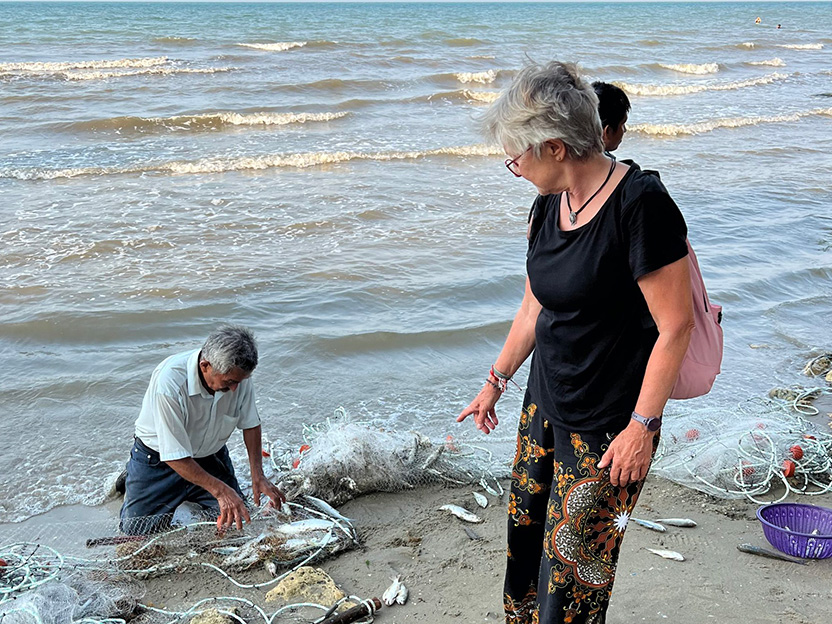
On the beach, I saw a family of fishermen hard at work. They were using the traditional fishing technique with nets. Using a boat, they positioned the nets in a semicircle relative to the shore, and from there, the women pulled the net’s ends, dragging it toward the shore, entangling the fish. They all entered the sea wearing regular clothes, which for the women meant wetting their traditional embroidered and heavy attire. I was surprised at how joyfully they worked! Despite the considerable physical effort, they joked and laughed. I think it’s part of their way of facing life.