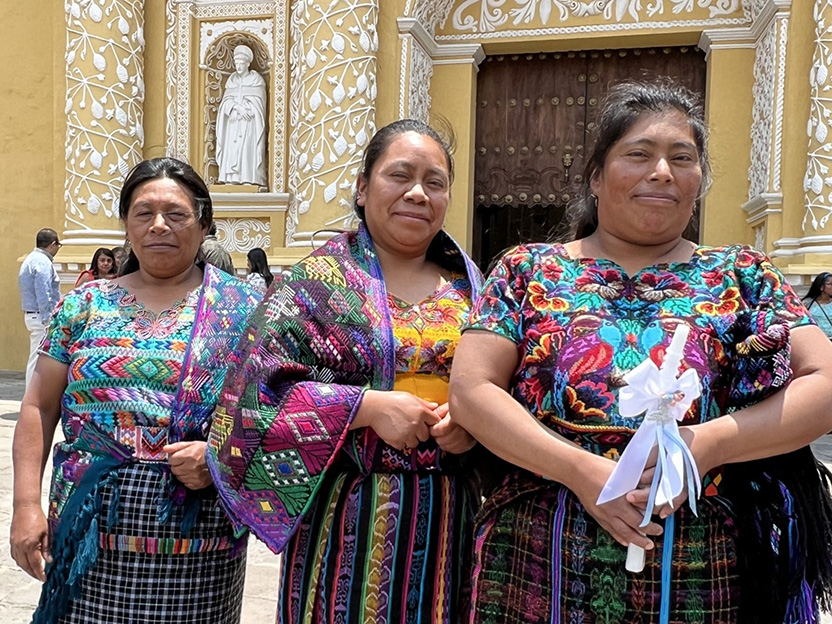
I wasn’t sure if I would be able to include Guatemala, and I’m thrilled that I did. The country’s vibrant colors will remain etched in my memory forever. I do regret not buying much at the artisan markets, though.
Some facts: Guatemala is the birthplace of Mayan culture. Its 18.6 million inhabitants speak 23 Mayan languages, Spanish, and Garífuna. Forty-four percent of the population is indigenous and lives almost in an independent world, where their own laws and norms are followed.
Guatemala boasts three UNESCO recognitions: the city of Antigua, the Mayan archaeological site Tikal, and the ruins of Quiriguá. It’s located in the Pacific Ring of Fire and experiences significant seismic activity. The last major earthquake was in 1976.
It has both Pacific and Atlantic coastlines and is known for its rich biodiversity. While its history is marked by violence, the current situation is peaceful, although the population seems disillusioned with politicians.
That said, Guatemala’s artistic and weaving traditions are impressive. They bear some resemblance to the handicrafts of other regional countries, but here, it feels like they’re more integrated into daily life.
ANTIGUA – The Beautiful
I arrived in Guatemala City at night and needed to get to Antigua. I couldn’t find the shuttle, so I booked an Uber. The 25-kilometer journey took about 45 minutes. It was the only time I felt scared in a car. The road was winding, with two lanes in each direction, no lighting, and poor visibility. Additionally, cars here often have very dark tinted windows, making it seem like we were floating on the road as there was no hint of the lane’s edge. We were accompanied by a group of about 50 motorcycles. These young riders enjoyed taking the mountain route on Friday nights. So, I arrived in Antigua with my adrenaline pumping. There were people on the streets, nightclub music filled the air, young people queued up, and an air of normality prevailed.
Antigua has been devastated several times by earthquakes, and its current 50,000 residents are well aware of this history. It was named “Antigua” (Guatemala) after being destroyed by earthquakes, several in the 18th century, which led to its abandonment by political and ecclesiastical authorities. Nevertheless, due to its beauty and colonial and ecclesiastical heritage, it is a UNESCO World Heritage site. Every corner of the city feels like a privilege.
Antigua’s Holy Week processions are one of Guatemala’s most attractive tourist events. You need to book your hotel well in advance.
Accommodation options are abundant, and colonial mansions and converted cloisters offer special charm. In fact, the city would be an excellent destination for incentive trips because it has a good range of hotels, excellent cuisine, quality service, and interesting excursions, including the active Pacaya and Acatenango volcanoes, the bustling market of Chichicastenango, and Lake Atitlan, which offers all the ingredients needed for a successful trip.
Mayan Fashion – More Than Clothing
The weaving tradition in Guatemala is part of the Mayan legacy, encompassing their art, culture, and religion. Cotton and natural dyes were traditionally used to create fabrics, woven using either a standing loom or waist loom. Each indigenous community has its own distinctive designs and characteristics. Mostly, it’s the women who continue to wear traditional garments, including the huipil (blouse with intricate embroidery), wrap-around skirt with embroidery of varying lengths, sash or belt, and sandals. Women take great care in artfully coordinating colors and designs, with each community having its own pattern or distinctive design. These outfits vary for ceremonies, daily wear, and special occasions. Each community has its own characteristic design, which helps them identify each other. These garments can be expensive, leading many young women to switch to “modern” clothing, as second-hand clothing from European donations, known as “paca,” is very affordable. Since 2011, efforts have been made to protect the weaving tradition of indigenous communities, including the establishment of schools for the next generation of weavers who will preserve the art’s value. The National Movement of Mayan Weavers, which brings together 30 weaving cooperatives from 18 linguistic communities, is calling for legislative protection that grants each Mayan community collective intellectual property rights to their traditional designs. In fact, I believe they should be recognized as UNESCO Intangible Cultural Heritage. I hope they succeed because these garments are authentic works of art.
Chichicastenango
The market in the town of Chichicastenango is one of the most comprehensive places to admire Guatemalan art. It takes place on Thursdays and Sundays and is usually visited on excursions from Antigua. Choosing something to buy can be a real challenge. I stopped at a stall to buy a mobile phone case… but they were all beautiful! After about 10 minutes, I was still there, deliberating. The shopkeeper’s children gathered around me and laughed heartily at “the lady who couldn’t decide.” In the end, we all tried on the clothes, swapped bags and cases from the counter, and improvised a fashion show. To the delight of the audience and the shopkeepers. When I left, the children followed me to give me candies… Sometimes you have to let go and bring out the child within…
Another curiosity of the town is the colorful cemetery. National Geographic declared it the “Most Colorful Cemetery in the World” in 2017. Tradition dictates that tomb colors are assigned based on the deceased’s role in the family: white for purity, turquoise for protection, yellow for the sun/humanity, and so on. Maya funeral rituals are also held there. While I was recording the video that I wanted to post on Instagram, a dog appeared behind one of the graves. We both jumped and “shouted,” then ran in opposite directions. Well… even death can be fun and colorful.
From there, the journey continues to Lake Atitlan. One could think they are in Switzerland, except for the volcanoes, boats with random schedules, and relaxed pace. Not to forget Maximón, whom you need to bring alcohol and tobacco to!
Lake ATITLAN
There’s everything here! Diving, kayaking, visits to coffee farms and bee farms, trekking, Ayurvedic massages and ayahuasca sessions, concerts, painting classes, local communities mixed with young and not-so-young expatriate groups, Mayan religious rites, and more. There’s something for everyone and every budget. Lake Atitlan is a vast volcanic crater surrounded by “The Three Giants,” three volcanoes, 18 kilometers long, and dotted with about ten towns along its shores. You can visit these towns either on an organized tour or by regular boat from Panajachel or some other town. However, you need to pay close attention to schedules to combine several towns in a day. I combined San Marcos, San Juan, and San Pedro on one day, and another day, Santiago and Panajachel. The towns are all very different from each other. San Marcos is known as a “hippie village” with a wide range of well-being services. San Pedro is popular among young people for its vibrant nightlife. In San Juan, despite being a tourist destination, I noticed the most presence of local crafts: small weaving workshops, beekeeping with stingless bees that produce exquisite honey, chocolate production, herbalism, and traditional fishing. Taking the tuk-tuk tour offered by the same drivers/guides at the pier is highly recommended. For about 80-100 quetzales (9-11€), the guide takes you to various workshops, the most beautiful places in the town, and can even drop you off in San Pedro, so you don’t have to wait for the boat and can enjoy the beautiful panoramic view.
Santiago Atitlan has the most visible Mayan legacy. Here, its 45,000 inhabitants, many of whom are of Tz’utujil or zutuhil origin, are engaged in agriculture and crafts. They are known for their veneration of the deity Rilaj Maam (the “Great Grandfather”), the nahual (witch or supernatural being) whom they consider the “great protector” because he has the power to mediate between the divine and the earthly. According to tradition, the character was found in a tz’atel tree, known as a pito tree, a common tree in Mesoamerican regions, from which sculptors carved his figure. He represents the synergy of Mayan and Catholic religions (Simón Pedro, Christ’s apostle). His main power is healing, but he also helps attract people’s love, protect against danger, succeed in business, and more. Maximón’s figure is displayed in an improvised chapel in a private house, which is chosen every year from early November to May. You can visit him and leave offerings of alcohol, tobacco, money, food, and make a symbolic payment of 5 quetzales. Honestly, it’s a bit hard to keep a straight face watching adult men venerating their deity with beer bottles, lit cigarettes, in an environment more like a smoky bar… It might be a matter of perception.
One of the traditions in Santiago is the use of the Tocoyal, a typical attire worn by Tz’utujil women. The slender ribbon is 16-21 meters long and is wrapped around the head 20 times, symbolizing the continuity of life. In fact, it’s depicted on the national 25-cent coin. You can visit the workshop and pay to take a photo with the headdress.
From here, you can trek to the San Pedro volcano. The ascent is not for beginners, but the view of the lake from there is spectacular. Moreover, due to the diversity of flora and landscapes along the way, Santiago is a perfect destination for birdwatching.
Along the lake’s shore, you’ll find various types of accommodations, from groups of cabins to secluded villas. Central America’s deepest lake has much to offer. In different towns, groups of expatriates and young people who have decided to stay for a while are forming. It will be interesting to see how the region develops. Hopefully, they can maintain the balance.