After my mesmerizing Andean Crossing through three pristine lakes and enchanted forests, I arrived in Bariloche—a bustling hub during the peak season. Finding accommodation was a challenge, irrespective of the price range, queues snaked through every corner, the bus station was teeming with travelers, and the service was sluggish despite three ticket counters. With more than a hundred people in line, decisions sometimes took 20 minutes, further lengthening the queues.
Exploring El Bolsón: El Bolsón, a town about 80 kilometers south of Bariloche, founded in the early 20th century, initially saw the presence of Syrian and Lebanese merchants. Today, it’s home to around 15,000 residents, experiencing urban growth and best known for its artisanal market, La Feria Regional de El Bolsón, and its reputation as a bohemian village. El Bolsón serves as a gateway to excursions to the Azul River and El Cajon del Azul (lagoon) and offers numerous hiking options.
A few kilometers further south lies Lake Puelo, an intriguing lake that originates on one side of the Andes but flows into the Pacific Ocean. Lago Puelo settlement is about 4 kilometers from the national park and natural reserve. The earliest settlers in the late 19th century were Chileans searching for pastures for their cattle. Today, it’s inhabited by around 10,000 people, with noticeable urban expansion. Approximately 20,000 visitors explore the Lago Puelo National Park annually. Moreover, there’s plenty of nearly untouched space around the Azul River and Lake Epuyén, along with trekking routes.
During my time here, I encountered a heartwarming story—three generations of women who have built and managed the three most beautiful establishments I’ve seen on this journey! Mrs. Ana Ordoñez purchased land in Lago Puelo in the mid-1990s. Over time, her daughter Ana del Moro and granddaughter Veronica constructed three adjoining establishments: “La Casa de Té,” “Sepia,” an ice cream parlor, and “Jauja,” a beer garden. All three places exude meticulous attention to detail, order, cleanliness, aesthetic harmony, exceptional service, and excellent value for money. I was told that the secret to their outstanding organization and quality is the unity of the family and support from friends. To the extent that the name “Sepia” is derived from the color of old family photographs, and the decorative items are from the family’s chest. The result is enviable.
Here, as in other Patagonian towns, I encountered paintings and graffiti advocating for women’s rights.
By this point, I had been traveling through Patagonia for about 1.5 months and decided it was time to let the experiences I’d gathered in the region settle. So, I took a flight to Mendoza.
Mendoza, the Land of Wine: Founded in 1563, Greater Mendoza has approximately one million residents and is primarily known for its wine industry and tourism. It served as the starting point for the Army of the Andes under the leadership of General José Francisco San Martín for the Andean Crossing in 1817, which led to Argentina’s independence in 1820.
I visited in January, and the city was relatively empty as people were on vacation. It was hot (around 36°C during the day), the air was dry, and there was dust in the air. The climate is rather arid. I noticed the leisurely atmosphere of a city on holiday, which allowed me to pay better attention to details such as:
- Small aqueducts along the streets used for watering the trees and drainage. They’re clean, spacious, unmarked, and unfenced. This means that during heavy rains, the city doesn’t flood, but it also means that a certain number of people fall into these ditches each year and break some bones.
- Spanish history is present in the decoration of parks and colonial mansions.
- Being in a seismic zone, the two major earthquakes in 1861 and 1985 have left their mark. The city’s construction is limited in height, and numerous parks serve as meeting points during emergencies. There are many parks of different sizes. If they have gravel paths, they are parks, and if they have pavement, they are squares. The parks in the four corners have smaller parks.
The Wine Capital: The region’s wine industry represents 75% of Argentina’s production. The expansion and professionalization of wine production occurred with the arrival of Spanish and Italian immigrants. Many wineries are in the Uco Valley and the Maipú area, reachable by tram from the city. The red wine Malbec is nearly synonymous with the city.
All kinds of wine tours are offered: by bike, with a guide, on horseback, with accommodation, stargazing, and more. There’s something for every taste. Since 1938, the great Vendimia Festival has been celebrated in early March, broadcast nationally on public television, and is one of the world’s largest outdoor events. It consists of several acts, including a carousel, parades with over 1,000 dancers, and the election of a Queen and a Princess. It’s the perfect time to visit the city.
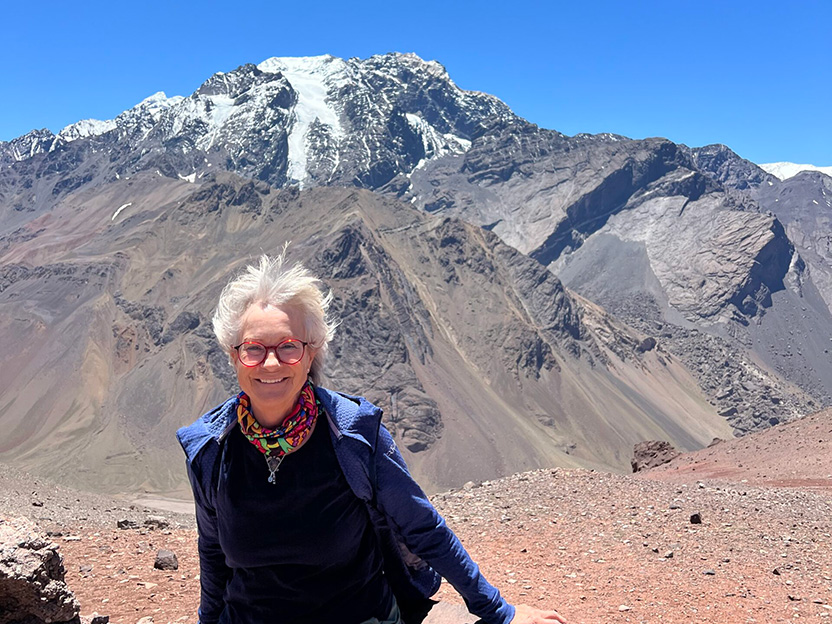
Touching the Sky: During my visit, I embarked on a tour to Aconcagua Provincial Park, the third-highest mountain in the world at 6,961 meters. I did it with the local company Viajes Conocer, and it was an experience that left an indelible mark on my memory. The minibus journey includes stops at Potrerillos Dam Lake, Puente del Inca with its peculiar formations (a UNESCO World Heritage site), and the breathtaking winding road to the Christ the Redeemer monument in the Andes, at an altitude of 3,854 meters. The monument was created by Argentine sculptor Mateo Alonso in Uspallata Pass in 1904 to commemorate the peaceful resolution of a border dispute with Chile. I have no words to describe the landscape. It was the first time I shed tears while gazing at a mountainous vista.
Let’s Fly! Since I was already at great heights, I decided to try an activity I had wanted to do for a long time. I also wanted to do it with a new friend from Mendoza, who is also over 65. So, we set out to prove that age should not be a limitation to take a leap and soar. And we did it with the company Andusfly.
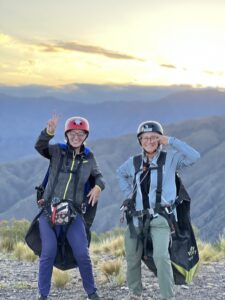
This company has been taking people soaring through the skies of Mendoza for 16 years. They know what they’re doing, understand the winds, have excellent equipment, and are aviation professionals. However, what truly makes paragliding an unforgettable experience is the human touch they provide. At no point did we feel discredited or different from passengers of other ages. We were treated with respect, kindness, professionalism, and utmost concern for our safety and the positive experience. This personalized treatment gave us the confidence to enjoy the flight and make the initial leap with joy. Diego and his team are fantastic.
On the landing strip, we met his mother and girlfriend. Once again, I found that essential family support for entrepreneurs. I was left wanting more, to continue flying, supported by a professional pilot, swaying in the air, laughing, and taking in the landscape. For a moment, I could be a bird. THANK YOU!
Conclusion: My journey through Patagonia and the Andes came to an exhilarating end in Mendoza, with experiences that touched my heart and soul. It’s proof that adventure knows no age, and the world is full of wonders waiting to be explored.