I’ve always yearned to venture into the Amazon. Is it the tales of Amazonian warriors that draw me? Or the immensity of the territory I once flew over, gazing for hours from the airplane window at the lush green expanse of the Amazon River and its tributaries? I was keenly aware of the importance of this region for our planet and the allure of the “undiscovered indigenous tribes.”
I guess I’ve always had a bit of an explorer’s spirit, and as Javier Reverte once said, “Women are more adventurous and great travelers than men.” He himself had explored this region and chronicled his journey in the book “El río de la desolación: Un viaje por el Amazona.”
Meeting Renata Marqués: One thing was clear, though – I couldn’t plan a journey to these remote regions and visit the tribes all on my own. Fortunately, fate smiled upon me when I crossed paths with Renata Marqués, a Brazilian residing in Rio de Janeiro, who specializes in organizing incentive trips for companies. What truly fascinated me was her years of travel experience in the Amazon and her involvement in various projects with indigenous women. She had a trip planned for December, the first one since the pandemic, to reestablish local connections. Two other remarkable women, a journalist and a Dutch collaborator, would join us. It was the perfect plan.
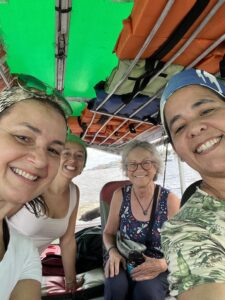
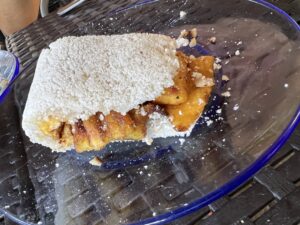
We all converged at a hostel in Manaus. After introductions, we embarked on our adventure with a hearty breakfast of tapioca bread, chestnuts, and bananas at the market. That’s where we were greeted by Divina, our first host. As we descended to the pier, we encountered a bustling scene – cars and vans loaded with supplies for boats, tourists with suitcases and backpacks, carts laden with tapioca sacks, people on bikes, dogs, and mud.
Setting Sail on the Amazon: Divina led us to a small boat moored sideways. I couldn’t help but chuckle, but the 115-horsepower engine had a different message – we were in for a speedy ride.
It’s difficult to put these impressions into words. From the delicious meals crafted from fruits and vegetables rarely seen or used in Europe, to the symphony of Brazilian Portuguese spoken by several people at once, the seemingly chaotic streets and pier reminiscent of Africa, and the camaraderie among my fellow travelers.
Navigating the Amazon: We set sail, and our first encounter was with the fins of Amazon River dolphins! They swam alongside us for a while. Then we reached the confluence of the Rio Negro and the Amazon, referred to as Solimões here. The blend of colors was striking, marking the point where the river takes on its unique character. Ultimately, the mighty Amazon flows into the Atlantic through a 240-kilometer-wide delta. This river contributes a fifth of the world’s freshwater that finds its way into the oceans.
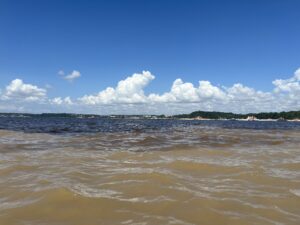
The river’s flow varies dramatically, depending on the volume of water during the rainy season from January to July. Floods can reach up to 20 meters, leading settlements to be strategically situated away from the banks, appearing as hills during dry seasons. Almost half the year, the land is submerged.
Exploring Indigenous Communities: Skipping the various stops and locales, let’s delve into my experiences with the indigenous villages and projects we visited. They were far from what one might imagine from the comfort of their own home.
Lesson One – Seeking Permission:
- First and foremost, you can’t simply visit indigenous villages unannounced. You must notify them, and they must grant consent. Only then. With prior acceptance.
Lesson Two – Managing Expectations:
- Second, whatever expectations you hold about encounters with indigenous people will differ from reality.
Lesson Three – Finding Common Ground:
- Third, to better process the wealth of information acquired during these encounters, it helps to seek similarities and apply common sense.
Lesson Four – Complexity of Indigenous Tribes:
- Fourth, the topic of indigenous tribes in Brazil is incredibly complex and would require a different type of analysis and writing. I’ll limit myself to sharing my observations.
Unique Encounters: In the first village, we were welcomed by two men in the “living room” of their home, typically a large hut where visitors are received. They had necklaces for sale and appeared somewhat apathetic, and it wasn’t due to the heat. When we asked them what one wish they’d have if it could be granted… they wished for solar panels. So they could watch television.
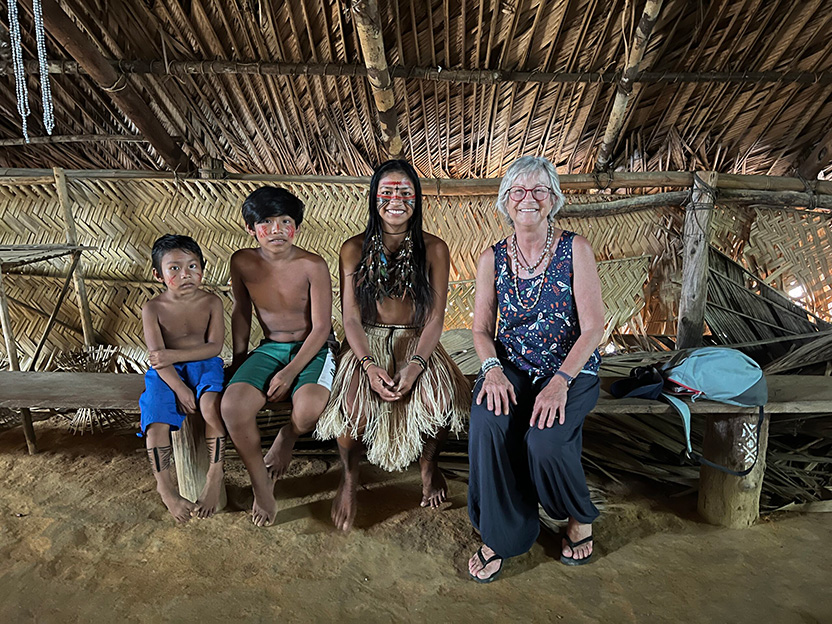
In the second village, we encountered several families from the Colombian Amazon, dressed in indigenous attire with painted faces. They had a considerable selection of handicrafts for sale and allowed us to take photographs. These two villages, being close to Manaus, received more frequent visits from tourists. For the Colombians, this represented a source of income, possibly with less risk than in their home regions.
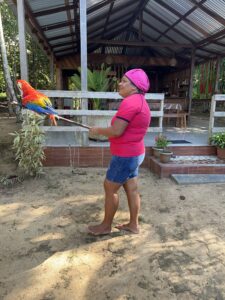
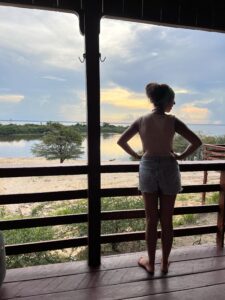
The Tranquil Retreat with Divina: We continued upstream to Divina’s estate, nestled in a secluded bay surrounded by forest. We chose rooms in her guesthouse and, after a refreshing river bath, enjoyed some drinks on the veranda while watching the sunset over the river. It was nothing short of magical. The chef, Cleya, had prepared a sumptuous dinner, despite the constant interruptions from the parrot Aurora, who was curious about everything :-).
 .
.  .
. 
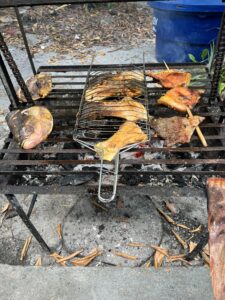
One of the dishes featured was grilled “tambaqui” or black pacu (Colossoma macropomum) fish. The fish was exceptionally flavorful, perhaps because it feeds on the fruits and seeds of the river. I can’t recall ever tasting fish with such a delicate, pleasing flavor and fine texture. Various tapioca dishes were also on the menu. I realized that I quite liked tapioca / cassava / yuca, and it was easier to digest than wheat flour.
As night fell, the sounds of the jungle and the distant hum of boat engines provided a soothing soundtrack.
Empowering Women Entrepreneurs: Divina is one of the enterprising women we were eager to meet. She had inherited a relatively large estate from her family, which had once been a bustling trading post complete with a school, worker dormitories, and even a chapel. In 2019, Divina began the renovation of the main house. However, the pandemic and torrential rains took their toll, causing damage to parts of the estate.
Her most significant challenge lies in maintaining the consistent quality of service. She carefully selects her collaborating partners, including the boat we traveled on and its captain. Divina is on the right path, and we wish her the best of luck.
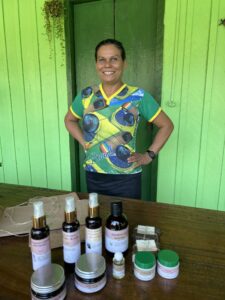
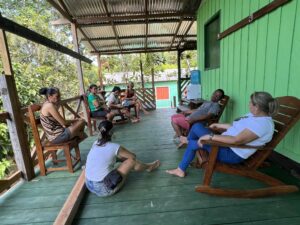
The Journey Continues: The following day, we set our course to the north, reaching the village of Yara in the Bellavista do Jaregui community on the Cueiras River. Here, we visited a cooperative of women who specialized in producing cosmetics using raw materials from the forest. Initially, they crafted only soaps, but as the group grew to over 100 people, they diversified. One group continued with soaps, while the other focused on cosmetics and shampoos. Everything they produced was organic, including the packaging. We suggested they modify the packaging of their products from 120ml to 100ml so that people could purchase them and take them on airplanes.
In their journey to specialize in production, they received assistance from a professor at the University of Manaus. He also connected them with a group of Indian NGOs working on Ayurveda. I tried some of their products. The fragrances were unfamiliar to me, but they were an absolute delight. Some were like a blend of jasmine and roses…
 .
. 
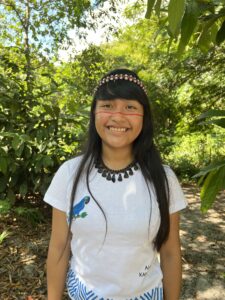
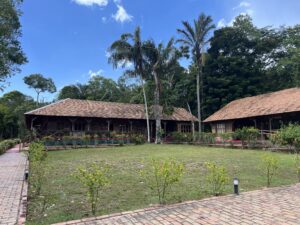
The next village, Povo Kambeba in the Três Unidos Community, turned out to be the most intriguing. We coincided with a boat that was delivering butane canisters to the village. What caught my attention was how perfectly coordinated the men were as they hauled the canisters uphill.
This village had solar panels, TV antennas, and even Wi-Fi. Approximately 120 people called it home. They boasted a large school with a dining hall, an internet room, and a dormitory for children who came from other villages and stayed there during the week. Additionally, they had two sports teams that participated in national competitions: one in canoe rowing and the other in archery. The stark contrast in development between this village and the others we had seen was evident. It was clear that the village leader was a pragmatic entrepreneur. The current school director and leader, Raimundo, had managed to implement the “fusion of interculturality,” which they termed as the blend of indigenous tradition with the modern world. He participated in conferences and regional meetings to explain his model of development and growth.
 .
. 
Meeting them was incredibly enriching. We received a warm welcome, had engaging conversations, and they enjoyed the photo session we organized. When we went down to the river for an evening swim, I felt an incredible sense of security, fulfillment, and integration with nature. Having spent most of my life in cities as an urban planner, I’m not as familiar with the natural world around me, especially in different latitudes. I’m immensely grateful for the opportunity for this closeness and learning.
What I Learned:
- When embarking on a long journey spanning several weeks or months, it’s crucial to schedule rest days in between. Preferably with good Wi-Fi.
What I Didn’t Learn:
- How to control my impulse to buy artisan souvenirs (I now carry four bracelets, two pairs of earrings, and two indigenous necklaces… all of them incredibly beautiful, by the way :-))
Stay tuned for more adventures in the Amazon!
#AmazonAdventure #ExploringTheRainforest #IndigenousCulture #TravelDiaries