Santiago de Chile marks my first visit to a major city in the last two months. I find myself staying in the heart of the city, hosted by a fellow traveler I met during the Navimag ferry journey from Puerto Natales to Puerto Montt. Those four days at sea provided ample opportunities for connection and conversation.
Elisabeth, my gracious host, has more to offer than just hospitality. As a child, I lived in Chile, somewhere between the ages of 6 and 9. I carry childhood memories of that time – memories of the house, the neighborhood, the school, and more.
One memory surfaced as Elisabeth helped me identify my old school by its logo: Colegio Sagrado Corazón. I recalled an incident where, as someone picked me up at the school gate, there were tears and a sense of general commotion. I inquired about the cause, to which they replied, “President John F. Kennedy has been assassinated.” I also remembered the school’s insistence on eating a dessert I despised – the wobbly, colorful gelatin. I made a stand against anything that jiggles!
Elisabeth took me to the address of my old home, and to my surprise, I gained access to it. The current owners kindly allowed me to visit the garden and my old room, the living room, and the terrace. The mandarin tree was no more. I recall climbing that tree from the terrace, picking its fruits, and trying to avoid getting caught. There was the spiral staircase I rushed down when the massive 1960 earthquake hit, and everything around me seemed to fall apart. The house, of course, appeared smaller than I remembered. Seeing it again was profoundly sentimental. Our family possibly experienced some of our happiest years there. I remembered childhood friends, two girls who lived in the house across the street. And as they say, “short story,” we managed to reunite, almost 60 years later. It was a meeting filled with strange sensations. We shared our life stories with closeness, noted the differences in our lifestyles and paths, and longed to relive our carefree childhood days.
They had experienced firsthand the changes during the “social outbreak” in 2019, which left a significant mark on and divided Chilean society. Opinions on both sides of the spectrum are deeply polarized. Santiago’s city center is covered in graffiti, closed businesses, lowered shutters, and several buildings damaged by fire or acts of violence. A metro station remains closed, serving as a symbol and a reminder. It’s worth mentioning that in recent years, an influx of immigrants from Venezuela, Haiti, Colombia, and other places has been noticeable in Chile. The increase in street violence and crime is often attributed to this.
In the central part of Avenida de los Alamos, the main street, there is a row of tents housing immigrants and homeless people. It’s clear that there are areas of the city where walking alone at night is not advisable. The Museum of Memory and Human Rights exhibits some historical data from the 1960s onward, and the new Museum of the Social Outburst displays objects and images used during the tumultuous months of October 2019 and the onset of the pandemic. It gives you plenty to ponder, but it’s not my place to express political opinions.
That being said, people here are friendly, and yes, everyone talks about politics – either for or against the social outburst. There are no “middle ground” views. I didn’t notice this degree of politicization in the rest of Chile.
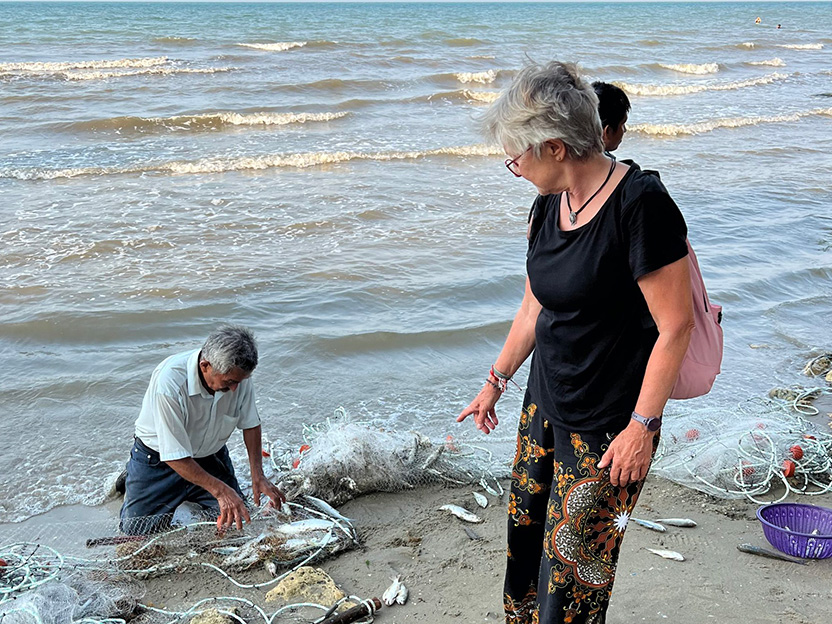
With my childhood friends, I ventured to the coast, visiting the magnificent Parque Tricao, strolling along the ocean’s edge, observing fishermen and flocks of birds. Nature always has an effective way of putting human conflicts into perspective.
Heading to San Pedro de Atacama: My next destination was to the north – San Pedro de Atacama. I had longed to witness the incredible starry skies of the desert and the famous Salar de Uyuni. The night bus ticket cost around €28, while the flight was €31, so I opted for the flight (still no checked baggage for me – I travel with carry-on luggage and a backpack; it’s complicated, and I’ll discuss it in another post).
I liked the village a lot and the overall experience. It felt safe for a solo traveler, and the variety of restaurants, bars, and a diverse community of fellow travelers eager to share experiences and information made it comfortable.
When I made a reservation at La Casa de Don Tomas hotel, I had no idea how fortunate I was with my choice. The construction is made of adobe, not particularly photogenic, but incredibly effective for temperature regulation, a crucial factor in the desert. It boasts solar panels and other sustainable technology. However, what impressed me the most was the strong sense of camaraderie among the staff, their attentiveness to detail, from maintaining the cleanliness of the surroundings to the khaki uniforms, constant replenishing of the 24/7 free coffee/tea bar at the entrance, and providing free water for guests. The pool with loungers and the garden were alluring. Additionally, there’s a new area called “El Refugio,” a true oasis in the desert.
I had the opportunity to speak with Jorge Poblete, the owner and current manager of the hotel, the son of the founder. His father, Don Tomas Poblete, bought about 10 hectares of land in San Pedro in the 1980s when there was hardly any electricity in the town. However, the nearby lithium and copper deposits indicated that the region would prosper. Furthermore, the ALMA project, a collection of 66 radio telescopes, the world’s largest ground-based telescope project, was situated there. I was struck by the fact that Tomas Poblete had married Milka, a woman of Croatian origin from Mlini, near Dubrovnik. Don Tomas and his son Jorge, along with their respective wives, managed the hotel’s construction in the 1990s and the care of its initial guests, including renowned astronomers and even Camilla Parker Bowles.
Jorge Poblete and his nephew Pablo have maintained the family management, emphasizing employee well-being. There’s no staff turnover (some have been there for 25 years), and new employees come on recommendations from current ones. Employee well-being and their rights are given utmost importance, which is evident in the way customers are treated.
I regretted not being able to enjoy such hospitality for a longer time because, of course, I was in the Atacama Desert, and there was much to explore!
San Pedro de Atacama and Beyond: The town of San Pedro de Atacama dates back to before the 16th century, and the early inhabitants were indigenous tribes engaged in herding. Over time, miners arrived, followed by itinerant vendors, and in the 1980s, the first backpackers. The Belgian priest Le Paige and the Australian La Bobi played pivotal roles in the town’s development. The former collected indigenous art from the high plains, which is now displayed in a museum showcasing 11,000 years of regional history. The latter managed the town’s first gas station (without electricity) and lodgings in the 1960s and 70s.
San Pedro now boasts around 200 travel agencies, and I had received recommendations for “Gato Andino” and “Estrella del Sur.“
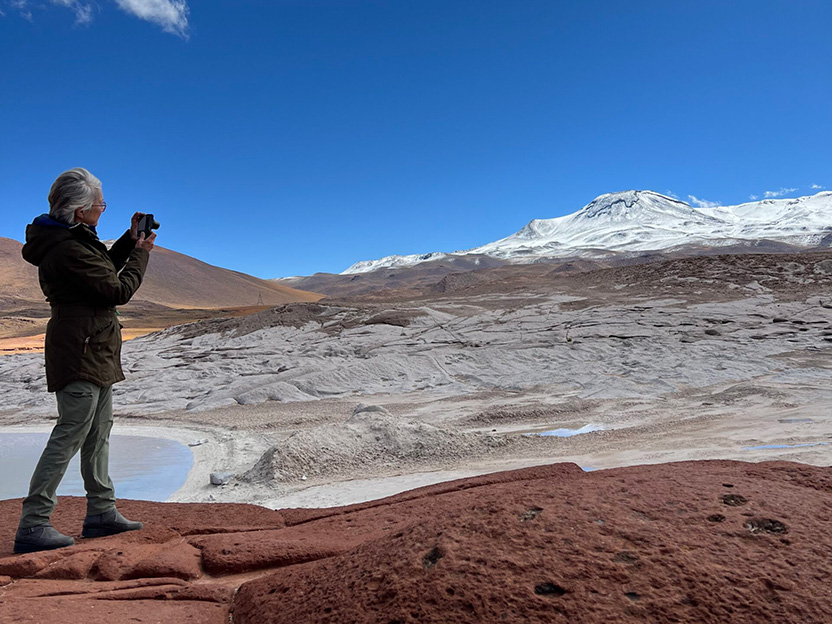
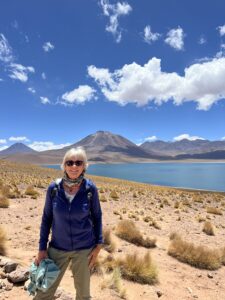
I was drawn to the name of the agency “Gato Andino,” and they are indeed involved in the Alliance for the Protection of the Andean Cat, an endangered species. Their guides spoke some of the best English I’d encountered on my journey. With them, I visited the Tatio Geysers. We were fortunate to see them first shrouded in thick fog, giving them an eerie appearance, and later, with the sun shining, revealing both geysers and volcanoes. On another excursion, we descended into canyons to walk along the Rio Grande, which was great fun. A visit to the Valle de la Luna (Moon Valley) was just as its name suggests. At Laguna Cejar, I bathed in the saltiest lake you can imagine! What impressed me the most, however, was the visit to the Red Stones and the Miscanti and Miñiques lagoons, all situated at about 4,000 meters above sea level, surrounded by volcanoes with matching names and mountains. The Red Stones are the result of iron oxidation, and the salty water is undrinkable due to its high salt, gypsum, and halite content, similar to the lagoons. The colors reflect the blue of the sky and ice, the green and yellow of the vegetation, creating an exquisite blend of hues. A paradise for photographers.
 .
.
Unfortunately, I couldn’t go on the stargazing tour because the sky was cloudy, and such tours aren’t conducted five days before and after a full moon. My timing was unfortunate.
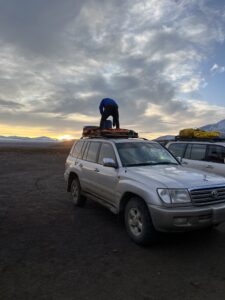
As the weather was changing, with storms and snowfall, the Bolivian agency Estrella del Sur decided to use a more remote border crossing into Bolivia from San Pedro. That journey was an entirely different experience! In a 4×4 driven by the cheerful Ronaldo, there was a young Dutch couple and a newlywed couple, she from Singapore and he from Italy. We bantered a lot because the “engineer husband” in the newlywed couple had meticulously planned every aspect of the trip, while the Dutch couple handled things on the fly. Two opposing ways of traveling, equally valid.
On the second day, the sun had come out, and we could appreciate some of the landscapes – La Copa del Mundo, El Camello, the Dali Desert, Italy Perdida, Laguna Colorada, the Anaconda Valley, passing through the town of Julaca, where we did a beer tasting. The consensus was that the quinoa and honey beer wasn’t good, the coca beer was passable, and the best one was Uyuni Premium. We slept in a Salt Hotel, where we were well taken care of, but I didn’t find it particularly exceptional. I’m not sure what I expected, but it felt like a “regular” hotel to me.
On the last day, we woke up early to witness the sunrise at the Salar. The road had disappeared due to rain, but we were treated to two rainbows!
As we ventured into the salt flats, having rented rubber boots (IMPORTANT), we could enjoy the surreal landscape of the salt flats. You couldn’t see the horizon, and the reflection of the salt flat’s water created optical illusions. We had fun taking photos. We didn’t want to leave…
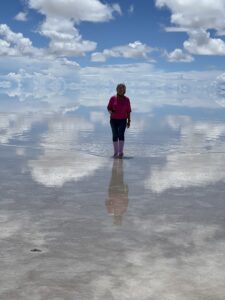
But the storm chased us away, and once we arrived in Uyuni, a town under construction with muddy streets, we dispersed as best we could.
I took a bus to Potosí, the mining heart of Bolivia…
What I Learned: I learned to trust my instincts a little more when it comes to people. During this journey, I’ve encountered a wide range of personalities, and I’ve thoroughly enjoyed this diversity, listening to human stories.
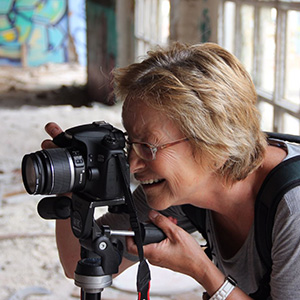
What I Didn’t Learn: I still haven’t learned to stop taking photos. When I’m in a breathtaking location, I struggle to put my camera down. It’s as if I need to keep capturing images to truly grasp the grandeur of the surroundings… and then there’s the task of editing those photos… or buying more storage space…