
While cruising aboard the Navimag ferry from Puerto Natales to Puerto Montt, I had the pleasure of meeting a charming young German couple who were both teachers. They had been journeying through these breathtaking landscapes since October. Given their plans to visit Chiloé for a few days, we decided to make the most of our time by renting a car and sharing the adventure. All three of us were licensed drivers, making the journey easier on everyone.
Getting Started: Before picking up our rented car, we took a delightful stroll through Puerto Montt, a city that pleasantly surprised us. I’ll save the details of that for another occasion. Renting the car turned out to be a breeze. We arranged to meet the rental company’s representative in the city, sent copies of our driver’s licenses (no need for an international one), and he had the contract ready. With no further ado, we checked the car’s condition (it was practically perfect, a spacious Nissan, and the daily rate was around €45) and set off for Castro, the current capital of Chiloé. We chose this city as our home base for its convenient central location on the island.
The Journey to Castro: The drive takes approximately 3.5 hours from Puerto Montt, including a 15-minute ferry ride. Ferries depart every 5 minutes, and the cost for a car and passengers is approximately €13.
Discovering Chiloé: Chiloé Island was settled by the Spanish in 1567, which is why most surnames on the island end in “ez” or “iz.” The island is home to roughly 200,000 people, with Castro now serving as its capital (formerly Ancud). Within the archipelago lies a thriving salmon industry, which remarkably continued uninterrupted during the pandemic.
The Western Shore’s Charms: The western shore, more exposed to the Pacific Ocean’s winds and less densely populated, is a region known for its incredible diversity of potatoes and its love for salmon.
They say it rains here 300 days a year, and the dramatic tidal changes during high and low tide are impressive. This is one of the reasons why stilt houses, called “palafitos,” were constructed. They also served as a means to control the illegal harvest of oysters. Though not many palafitos remain today, as they’ve been replaced by newer structures, you can still find a majority of them in the former island capital, Castro. Ancud boasts many colorful houses as well.
The construction of these houses is charming, typically crafted from alerce and coigue wood, known for their resilience. Some houses are adorned with alerce shingles, and cypress is often used for pillars. Notably, Chiloé’s wooden churches, built following the Chilote School of Religious Architecture, have been declared UNESCO World Heritage Sites. The island has preserved its rich tradition of artisanal woodworking and wool craftsmanship. Local markets offer a wide array of these handmade products, and what’s unique is that the sale of foreign goods is strictly prohibited (a fantastic idea!). These markets also serve salmon ceviche with shrimp and shellfish, available starting at €3 per serving.
While there aren’t many hotels, you’ll find hostels and, especially, cabins scattered across the island, including within the natural park. The rental cost for a cabin accommodating two people is approximately €50 per night, and for six people, it’s around €80 per night.
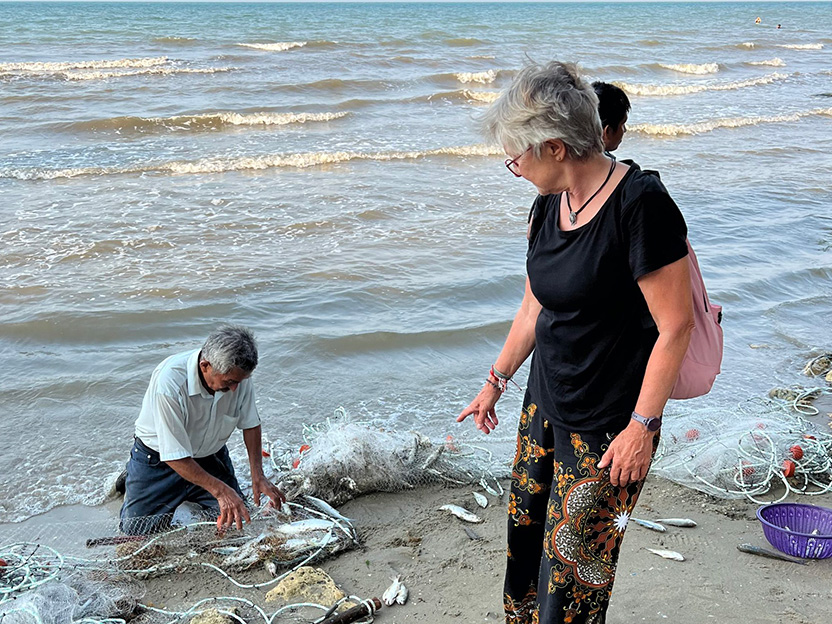
Meeting Shellfish Harvesters in Ancud: During our visit to Ancud’s port, we were fortunate to witness the arrival of a group of shellfish harvesters. These three seafarers had brought in a remarkable 180 kilograms of shellfish. To harvest these treasures of the sea, they don neoprene suits and employ hoses up to 100 meters long, connected to a compressor onboard their vessel. The sea’s temperature during this season doesn’t exceed 16°C, and they often spend hours at sea. The wholesale price for a kilogram of shellfish was €0.30. The life of a fisherman is demanding, no matter where you are in the world.
Chiloé: Flora and Fauna: While there’s excellent local bus connectivity across the island, traveling by car offers a more practical means of getting around. The abundant rainfall, reaching up to 4,000 mm, and the temperate climate, averaging 11°C, create unique ecosystems of flora and fauna on the island. Chiloé National Park, Tepuhueico Park, and Tantauco Park stand as the island’s three most important reserves. In these parks, you’ll encounter endemic tree species such as arrayán, oak, coigüe, and hazelnut.
Marine life around the Chiloé archipelago varies with the seasons and the side of the island you explore. On the oceanic side, you can spot blue whales, southern right whales, orcas, dolphins, Magellanic penguins, and Humboldt penguins. The best place to observe penguins is from Ancud, in a bay with three islets where they nest. You’ll board boats equipped with special staircases pushed by the crew to keep passengers dry during boarding—a unique sight indeed. Unfortunately, the populations of Magellanic penguins and dolphins are threatened due to the numerous trawl-fishing boats in the international waters along the Chilean coast.
The island is also a haven for birdwatchers, offering a wide variety of species, including herons, kingfishers, Araucanian pigeons, diucas, canaries, woodpeckers, swallows, hummingbirds, seagulls, cormorants, and more.
Chiloé: Land of Myth and Sea Creatures: The island’s dense forests, misty landscapes, diverse fauna, and frequent rainfall, combined with its proximity to the sea, have given rise to a rich Chilote mythology. This folklore is a fusion of the beliefs of the island’s original inhabitants (the Chonos and Huilliches) and the legends and superstitions brought by Spanish conquistadores. You’ll find numerous statues, books, murals, and references to this captivating mythology across the island, along with routes that explain these tales.
Mythological creatures are categorized as either marine (with a hierarchy) or terrestrial, followed by humans with magical powers. These stories are absolutely fascinating. For instance, there’s a myth about Trauco, a dwarf who supposedly impregnates young women at night—quite the enigmatic character! Most of these legends revolve around a fear of the sea and magical beings that enchant or abduct islanders, luring them into the ocean. In many cases, these beings punish disobedient and beautiful young women—quite the mystery indeed!
What struck me as particularly intriguing was the figure of a calf with a unicorn-like horn—known as Camahueto. Legend has it that Camahueto begins its life from an underground piece of its horn. After 20-30 years, it emerges and sets off for the sea in search of a sea cow. Along its path, it destroys everything in its way, creating streams with its enormous horn. This is said to occur on stormy nights—a tale worth exploring in literature.
I couldn’t help but imagine a statue of Camahueto, with its horn protruding from its forehead like a unicorn, in the midst of Wall Street. Perhaps a vision more fitting for the happenings in that neighborhood!
Exploring Chiloé in 4 Days: In just four days, you can cover the island’s main points of interest, making it a perfect destination for a short getaway.
Final Thoughts: As I reflect on this journey, I’m reminded of the joy of traveling with companions. It’s not only more cost-effective, but I’ve also seen people travel together, not because they’re couples or even close friends, but due to a relative alignment of interests and to reduce costs. Furthermore, traveling with others simplifies the experience, as four eyes truly see more than two.
Yet, there’s one lesson I still struggle with—patience when dealing with internet speed. In this part of the world, internet connectivity is a challenge. In 80% of the cases, when I checked my phone, there was no coverage (even with local SIM cards). In 10% of cases, there was some internet access (with download speeds as slow as 1MB and upload at 0.7MB), and in the remaining 10%, there was relatively usable connection. Internet is crucial for planning the next stages of the journey, and for a 5-month trip, meticulous planning is nearly impossible.
Chiloé, with its blend of natural beauty, rich culture, and intriguing mythology, left an indelible mark on my journey. It’s a destination worth exploring for anyone seeking a unique adventure.